
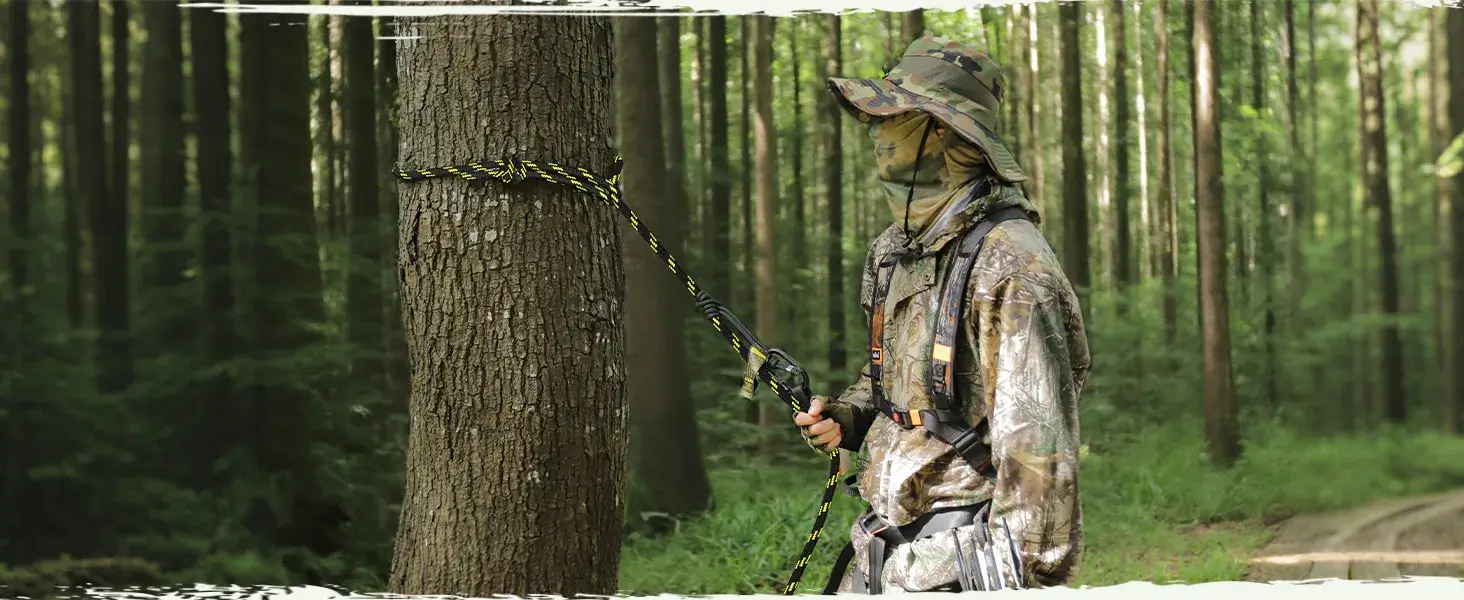
Safety is the most important factor when hunting from a tree stand. A fall from a few feet above ground can cause severe injuries or worse. That’s where tree straps come in.
Among the most widely used are web-style tree straps and rope-style tree straps. Many hunters wonder: how to use rope rope-style tree strap and whether it’s better than the traditional flat web strap.
In this guide, we’ll cover everything you need to know, from differences to proper usage, plus recommendations for the best tree straps available.
What Is a Rope Style Tree Strap?
A rope strap of the tree is a safety tool constructed out of a tough woven rope, typically polyester or nylon. It connects the harness of a hunter to the tree to ensure that you are safe in a stand as you hunt.
The majority of the straps contain a carabiner and a prusik knot. The knot is capable of movement up and down the rope, but when hard pulled, it automatically locks and prevents falls.
The primary objective of a rope-like strapping is to minimize the injuries of slipping or falling while sitting or standing on a tree stand.
Straps can carry many hundreds of pounds, hence remain strong in difficult circumstances. A rope strap is small, easy to carry, unlike big safety gear, and is therefore handy when hunters want a quick and quiet rig.
Is it needed? Yes, definitely. The greatest number of accidents in treestands occurs when you climb or get adjusted in the stand. You are tied to the tree with a rope strap that ensures you are never at risk of falling seriously. Nowadays, a web strap or a rope-like fall-stop is not something optional, but a necessary safety measure.
Rope Style Tree Strap vs Web Tree Strap
The question many hunters ask themselves is: What is the difference between rope-style and web-style tree straps? Let’s break it down with technical details.
Shape and Material:
- Rope straps are constructed of round braided rope, typically of synthetic fibers that are resistant to sun and weather. They do not break and become tough in cold or wet weather.
- Web straps are flat and constructed out of heavy nylon or polyester webbing. They are usually heavily stitched to give them some additional strength.
Adjustability:
- Rope straps are a prusik knot, allowing you to make minor adjustments along the rope. It implies that hunters will be able to switch positions fast and silently, without clicking buckles.
- Web straps use metal or plastic buckles, which can get stiff in cold climates and may be difficult to operate with gloves.
Noise Factor:
- The rope straps are less noisy as they do not have any metal buckles that bang. Bark is also grabbed more softly by the rope, and it makes less noise.
- The web straps are noisy on tightening or adjusting, particularly when it is too cold.
Versatility:
- Rope straps can be used on trees of varying sizes, including those as large as 20 inches or bigger. Additionally, some hunters use it as a tree climbing rope for ascent and descent.
- Web straps can also be problematic with large or small trees, based on their length and the type of buckle. It can only be used for connecting to a hunting harness while in the tree.
Rope straps are preferred by many hunters, as they are easy to adjust and silent, compared to web straps, which are cheaper and suited to the beginner.
Can You Use Rope Rope-Style Tree Strap for Climbing?
Most hunters wondered whether the rope-style tree straps are a complete safety lifeline when climbing up and down the tree. The quick answer: No, normally they don’t.
A rope-style tree strap is specifically designed for static use while in the stand. It secures the hunter once seated or standing in place, but does not provide continuous vertical protection while climbing.
A true safety lifeline system runs from the base of the tree to the stand and keeps hunters attached at all times with a sliding prusik knot or mechanical ascender.
With that said, lifelines can be very well supplemented by rope straps. Hunters normally utilize a lifeline when climbing and alternate to a rope-like tree strap when stationary hunting. This combination will have full coverage on all the ground up and down again.
It is not safe to depend on a rope-style strap when climbing because it is not very safe in case of a slip halfway up. To be on the safe side, hunters must always use a rope strap and an appropriate climbing lifeline system.
How to Use Rope Style Tree Strap?
A tree strap in the form of a rope is easy to use, and correct measures are essential to be taken regarding safety. Here’s how:
- Position the Rope Around the Tree: Wrap the rope around the tree with your height being the level of your shoulders. This will keep you on your feet in the event of a slip.
- Attach the Carabiner: To shape the length of the strap, slide the prusik knot up or down. Always lock before weight is added to it.
- Adjust the Prusik Knot: To trim the strap, squeeze the prusik knot up and down. After being adjusted, the knot will go tight when it is under pressure, trying to ensure that you are stuck.
- Pair with Accessories: For full safety, pair the rope strap with a body harness and possibly a lifeline for climbing. Many hunters also use bow hoist ropes to raise and lower gear.
- Double-Check Before Settling: Check the strap before the hunt by applying a minor amount of pressure to the strap. Make sure the prusik knot clips.
Pairing with Other Accessories
To be perfectly safe, use a tree strap with a full-body harness, lineman belt, and a climbing safety lifeline. The harness must be TMA (Treestand Manufacturers Association), and the belt the lineman uses to ensure controlled hands-free climbing.
A safety lifeline attached with a sliding prusik knot keeps you connected on the ground to the hunting height. These accessories send out fall forces equally, decrease shock loads, and collaborate to minimize severe injuries on accidental slips.
Key Safety Considerations
- Hunters should inspect the rope for fraying, UV damage, or weakened knots.
- Always test the prusik knot before committing weight, and never exceed the manufacturer’s load rating.
- Maintaining constant attachment is the golden rule of safe treestand hunting.
See how we use the Kalkal rope tree strap while hunting in the tree:
Best Tree Straps For Hunting
Here are five tree strap recommendations from five different brands. Let’s check out their product designs, features, and pros, and see what customers love about them.
1. Hunter Safety System Rope Treestrap
It is a rope-shaped treestrap (as opposed to a conventional web strap). It is nine feet long. The design is supposed to be a lifeline for climbing.
It has a self-tightening Prusik knot. The strap comes with a carabiner. Most trees can be accommodated by the rope.
Pros: The strap is light and safe. It makes climbing simpler and safer, and also serves as a connected rope to your harness. It also has a 360-degree shooting.
2. Muddy The Safety Harness Tree Strap
It is a web strap design. It is composed of a tapestry nylon belt. The product has a big, long-lasting loop.
It includes a steel buckle that can be tightly tied. The strap is also double-stitched to have better durability. The weight rating is 300 pounds.
Pros: This tree strap is simple to install. It gives a dependable guide around the tree. It is produced using heavy-duty weatherproof webbing.
3. Kalkal 10ft Rope Style Tree Strap
It is a rope-style tree strap and a bow hoist rope kit. The safety rope is constructed of anti-slip braided nylon. It comes with a hoist rope to haul your gear from the ground up to the stand.
The safety rope is up to 300 pounds. It has a Prusik knot system in it. The hoist rope is able to carry up to 100 pounds. A great combo for climbing up the tree with your hunting gear.
Pros: This is a safety strap, as well as a hoist rope. It has a good grip since it is anti-slip. The surface is non-reflective and silent.
4. Blocker Outdoors Rope Tree Strap
This is a rope, sort of a tree strap. It is composed of natural green, silent substance. The design has a unique reflective yarn to be used in low light.
A Prusik knot can be easily changed on trees. It is silent and has a steel locking carabiner. It has a safety harness that is compatible with the strap for full body protection.
Pros: It has a light and robust design. There is no metal rattling buckle in the strap. It can also be adjusted and used very easily.
5. Tree Spider Rope Style Tree Strap
This is a rope-type safety system. The rope is 30 feet in length. It is accompanied by a carabiner and a sound dampener.
Prusik connection slides for easy movement. The rope is of reflective material. It has a Recon carabiner and Cowbell sound dampener.
Pros: The rope becomes lighted with a flashlight beam. It wipes away rattles and clangs. Its length is up to 30 feet.
Which One Should You Choose?
The choice of a rope-style or a web strap as a tree type is usually a matter of individual hunting preference and priorities. To assist, it is worth considering what hunters on said about their real-world performance.
We have collected some of the feedback from the top hunters:
Rope Style Tree Strap Feedback
- Rope straps are popular with many hunters since they are quiet and less likely to cause metal to clink with climbing sticks. A user who used Amsteel ropes observed that the greatest advantage was not only the ease in weight but also the silence.
- Rope enables the hunters to adjust the length with ease and fit bigger trees. A few members of a certain forum have observed that buckles may be restrictive to oversized trunks and that rope straps are more versatile.
- One of the hunters mentioned that the ropes are safer because any buckle mechanism might not work, but that was a minor risk.
- Some hunters use climbing-grade rope to manufacture their own rope straps, altering length and knots. They stress the use of the static rope that does not stretch when under pressure.
- One of the hunters told of the incident in which his rope strap literally caught up his fall when his climbing stand slipped.
Web Style Tree Strap Feedback
- Cam buckle straps are still in use by some hunters due to their simplicity. They also like the fact that they are fast to install: wrap, clip, pull tight, and they are ready.
- One experienced hunter argued that the noise from cam buckles is a “non-issue” once padded with stealth strips. He valued the snug, no-slack hold that buckles provide.
- Others felt that web straps are better for hunters who don’t want to learn knots or deal with rope management in the dark.
Cost and DIY Factor
Several hunters pointed out that making rope straps yourself is possible, but the savings are minimal unless you’re outfitting multiple stands.
High-quality ropes and climbing-rated carabiners cost nearly as much as buying ready-made straps from trusted brands.
Some prefer to buy from companies like Hunter Safety System or Blocker Outdoors to avoid second-guessing their knots and rope choices.
How To Choose:
- If silence and versatility are your top priorities, rope straps are often the better choice. They fit more tree sizes, adjust easily, and cut down on noise.
- If speed, familiarity, and simplicity matter most, web straps with cam buckles remain reliable and user-friendly.
- Many hunters actually use both. Rope straps for stands they frequent often, and web straps as backups or for quick setups.
Conclusion
When hunting from a tree stand, it may always be risky, but the correct tree strap will assist in avoiding a catastrophe. The rope-style tree straps are unique in that they are silent and can be adjusted quickly, and can fit almost any tree size.
They are easy to carry, dependable, and are trusted by hunters who consider both comfort and safety. Web straps, in their turn, are also quite a viable option to those who favor more basic, buckle-based solutions.
The most suitable decision is a matter of style and priorities at the end of the day. A rope strap will be wiser, in case you are interested in quiet, versatile performance and secure protection by knots.
A web strap can also provide reliable safety, although speed and simplicity are your primary considerations. Having both is of value to many hunters as they are always ready to be used in varying hunting arrangements.
Whichever course of action you take, always bear in mind that the golden rule is to be always attached. Combine the strap with a good safety harness and climbing line, and you will have a more enjoyable time in the tree, knowing you are well protected in the tree.

Leave a Reply