
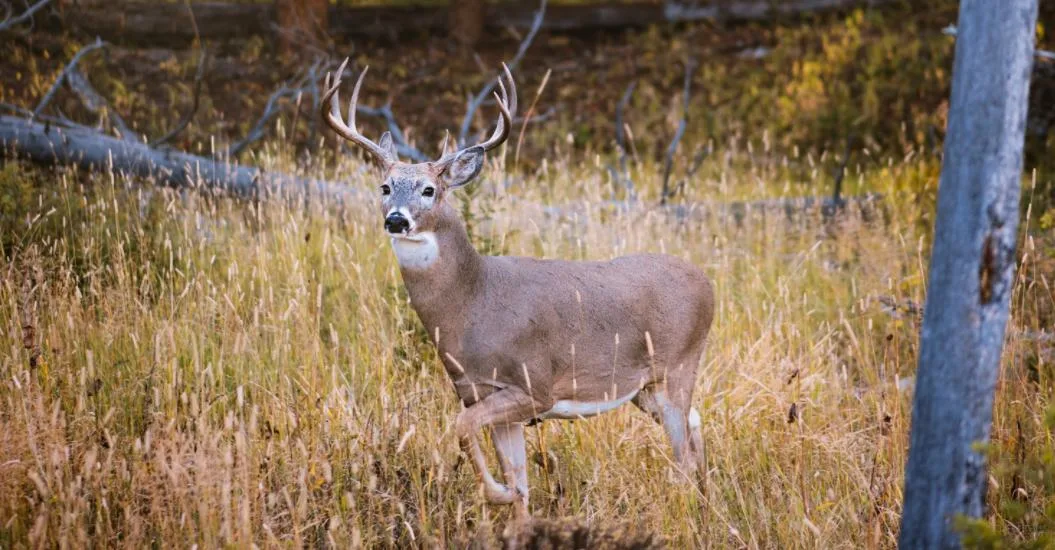
It may seem impossible to determine when a mature buck is going to appear. That is where the 7-day rule comes into play: a deer, particularly the buck, follows a repeated cycle of about seven days every year.
Many veteran hunters use this rule to plan their hunts because they think that it can accurately predict the movement of the deer.
Learning this trend can be a breakthrough. It will enable you to plan your hunts just in time to minimize wastage of time and maximize the success rate. In this guide, we are going to make the 7-day rule for deer hunting actually work and provide a breakdown on how you can actually test it in your area.
Deer 7 Day Rule: What Is It?
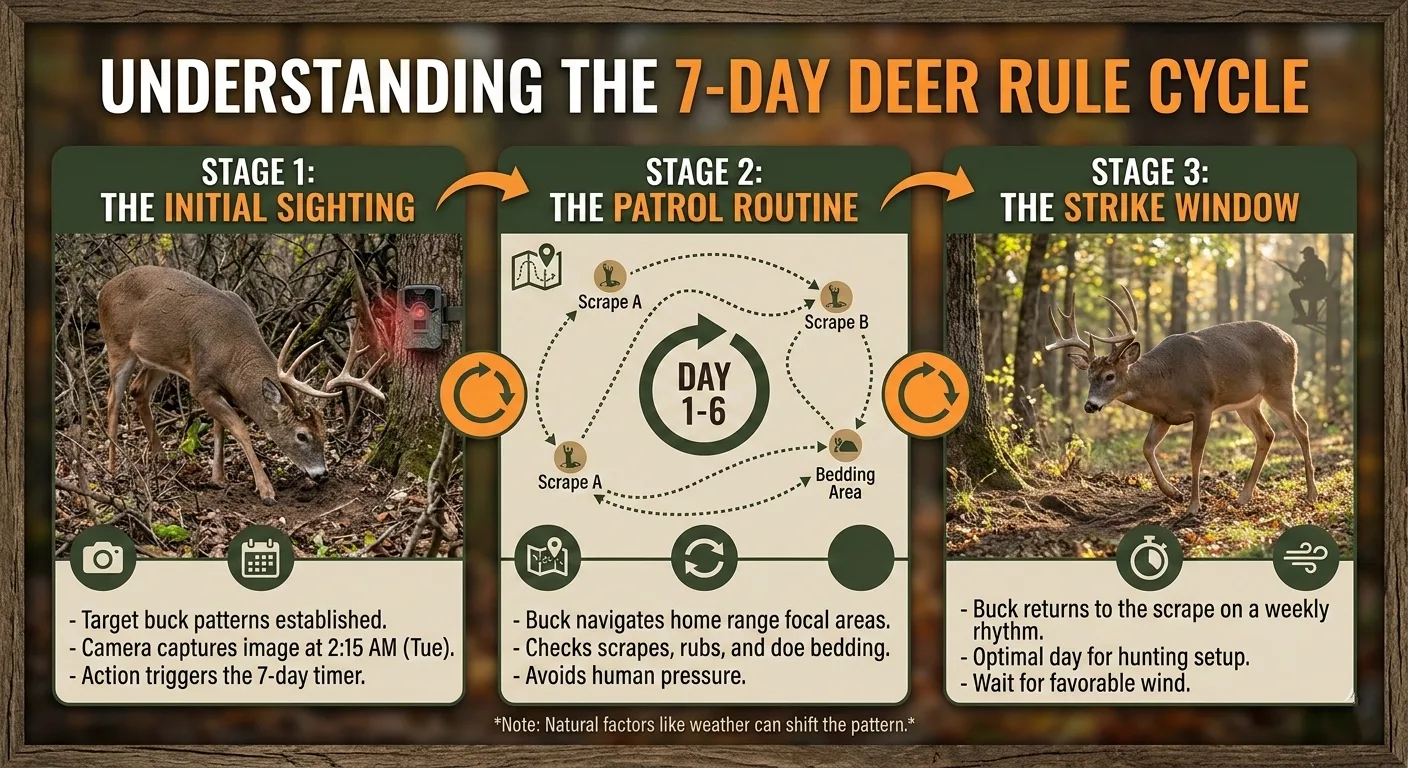
The 7-day deer rule is a hunting strategy based on the idea that mature bucks often return to the same spots on a predictable 7-day cycle. These spots include scrapes, food sources, or bedding areas.
If you capture a target buck on a trail camera, this rule suggests you have a high probability of seeing that same buck in the exact same area approximately one week later. It may not be that hour, but in a day or two of that weekly cycle.
This concept can be traced back to the time of hunters and wildlife observers who began to observe the same pattern in the movement of the deer.
The data provided by trail cameras and field observations have shown that deer tend to travel in specific directions, particularly in instances where they are not under pressure caused by hunters.
How Does It Work?
The pattern occurs due to the fact that deer live according to a schedule. They depend on the regular food supplies, routes of traveling, and resting places.
Once a buck feels secure in a location, he may actually return to the same location on a regular basis to feed, check scrapes, or scent-mark territory. These visits are further predictable during the pre-rut and rut seasons.
Bucks regularly visit scrapes or rub lines no less than once every week to update scent marking or do surveillance. The 7-day cycle is frequently in line with the natural cycles of deer behavior.
The reason this rule works is simple: data from the Mississippi State University Deer Lab suggests that most mature bucks maintain 2-3 “focal areas” within their home range. Their research shows that bucks often visit these specific hubs every 24 to 28 hours during the rut, but their “net displacement” (how far they move between hubs) changes daily.
The 7-day rule essentially tracks the window when a buck’s rotation brings him back to your specific focal area.
The Science Behind the Pattern
This 7-day cycle isn’t just an old hunter’s myth; it is rooted in deer biology. A buck’s travel pattern during the pre-rut and rut is heavily driven by testosterone levels and photoperiod (the amount of daylight).
According to research highlighted by the National Deer Association, mature bucks move more as the rut peak approaches, and run a specific circuit to check doe bedding areas and scent-mark their territory.
Because they cover a consistent geographical loop at a walking pace, it naturally takes them about 5 to 7 days to complete the circuit and return to your trail camera’s location.
How To Find The 7-Day Window?
The 7-day deer rule sounds simple, but finding your deer’s specific window takes effort and data. Here’s how to identify and use this pattern effectively.
1. Use Trail Cameras to Identify Patterns
It is most appropriate to begin by installing trail cameras in probable areas of deer. Place them in the vicinity of food plots, traveling routes, and sleeping quarters. Once you see the same buck in 6 – 8 days of photos, that is your possible pattern.
Keep the cameras on during the various seasons. The data will also be able to show whether the deer has a weekly routine or adapts to the rut or pressure in the long term.
To understand how strict this schedule can be, consider a field test by our pro team. A mature 10-pointer showed up on a scrape camera at 2:15 AM on a Tuesday. Instead of overhunting the stand the next day and leaving human scent, we waited.
Exactly one week later, on the following Tuesday, a cold front dropped the temperature by 15 degrees. We slipped into the stand that afternoon, and true to the 7-day rule, the same buck appeared at 4:30 PM, working the exact same trail.
2. Find Typical Locations Where Deer Appear
It is also important to know the way deer prefer to move as well. Such places are usually funnels, rub lines, scrapes, and field edges.
You can determine by walking around your grounds or by examining topographical maps. Deer like to move in natural cover such as tree cover or creek cover.
When you discover footprints such as fresh drops, tracks, or mock scrapes, leave your camera there. These are the most common areas that the bucks will revisit in their 7-day loop.
3. Know the Key Factors Behind the Pattern
Several environmental and biological factors affect how consistent the 7-day rule will be.
- Rut Period: During the rut, bucks travel more frequently, often sticking to patterns for checking does.
- Scent Marking: Bucks refresh scrapes and rubs on regular cycles, often close to every week.
- Food Sources: Deer follow dependable food sources like acorns, cornfields, or clover plots.
- Pressure: If hunters disturb the area, deer may change their timing or move elsewhere.
By combining these factors with camera data, you can accurately predict when your target buck will return.
4. Analyze Past Data
You have already been running cameras for several seasons, and you have some valuable information. Go back and see when certain bucks came out every year.
You will often find that the same bucks, having grown to maturity, will recur in the same locality during or about the same week of the year. The reason is that the behavior of deer is affected by the photoperiod, or the length of daylight in a day, which remains the same every year.
Having sufficient information, you will be able to create a dependable history of the deer tracking and identify your optimal hunting days quite early.
How to Test the 7 Day Rule on Your Location?
The 7-day rule is not certain to work all the time. It is relative to your local area, the concentration of the deer, and the level of pressure. Nevertheless, it is easy to test as long as you have a systematic process.
Step 1: Gather Data with Multiple Cameras
Install at least three to four trail cameras in various areas within your hunting property. Put them in traveling tracks, bedding areas, and feeding areas. Ensure that the cameras are timed and motion sensitive.
Allow two or three weeks to pass. The idea is to gather information regarding the time of passage of deer, especially of the mature bucks.
Step 2: Log and Compare Activity Dates
Write a logbook or an Excel spreadsheet to track the photo times and dates. Emphasize repeat visits by the same buck. When you notice a pattern, say you notice a buck every 6-8 days, you have probably identified your 7-day cycle.
Step 3: Test the Theory
Now comes the fun part. Hunt on the anticipated day of return. As an example, when your buck is seen on the 8th of October, go to hunt about the 14th or 15th.
Get up early in your stand and keep on the alert during the time period he comes into view. The buck can appear a few hours earlier or later sometimes.
A trial in different sites across time will assist you in determining whether the 7-day rule is really applicable to your property.
Step 4: Use Tools to Refine Your Predictions
Modern hunting tools make testing the rule even easier. Use apps like DeerCast, HuntStand, or Spartan Forge to overlay your camera data with weather and moon phase information.
Combining the trail camera data and weather can help refine that 7-day window, whether it is tied to specific environmental conditions, like cold fronts or moon illumination.
Step 5: Keep Notes for Multiple Seasons
Consistency is key. Test the 7-day theory over several hunting seasons. If your observations align year after year, you can trust the pattern and plan hunts confidently around it.
When 7-Day Rule Work Best?
The 7-day rule shines under certain conditions. Knowing these can help you decide when to trust the pattern and when to adjust your strategy.
- During the Early and Pre-Rut Periods: Bucks are still predictable and focused on feeding areas and territory marking.
- In Low-Pressure Areas: Deer stick to patterns when they feel safe. Private lands or remote zones often show stronger 7-day consistency.
- Stable Weather Conditions: When there’s no drastic temperature or wind change, deer maintain their normal routines.
- Consistent Food and Water Sources: If your property has a reliable acorn drop or food plot, deer movements become more rhythmic.
What Are Some Reasons The 7-Day Rule May Fail?
Like any theory, the 7-day rule isn’t foolproof. Several factors can break the pattern and throw your predictions off.
- Human Disturbance: Frequent visits to check cameras or scent contamination can spook deer, causing them to alter routes.
- Weather Shifts: Sudden temperature drops, heavy rain, or high winds can delay or change deer movement.
- Breeding Season Distractions: During peak rut, bucks may abandon their normal loops entirely to chase does.
- Food Source Changes: If crops are harvested or acorns stop dropping, deer will move to new feeding areas.
- Predator or Hunting Pressure: Increased coyote activity or nearby hunters can make deer go nocturnal or relocate.
Your 7-Day Rule Implementation Checklist
Before you head into the woods, follow these exact steps to capitalize on the 7-day window:
- Log the Initial Sighting: Record the exact date, time, and weather conditions when a target buck appears on your camera.
- Mark the Calendar: Highlight days 6, 7, and 8 from the initial sighting. This is your strike zone.
- Check the Wind: Never hunt the spot on that 7th day if the wind direction is wrong for your stand. If the wind favors the deer’s nose, wait for a better day.
- Factor in Weather Fronts: A significant temperature drop on day 6 or day 8 might cause the buck to shift his schedule slightly. Use weather fronts to your advantage.
Frequently Asked Questions
What exactly is the 7-day rule for deer hunting?
Is the 7-day rule backed by science?
How do I pick the right 7-day window?
Is the 7-day rule reliable for both private land and public land?
What if the buck showed up a different week this year?
How many years of data do I need to trust the pattern?
Conclusion
The 7-day rule for deer hunting offers hunters a fascinating way to predict deer behavior using data and patience. While it’s not a guaranteed formula, it’s a proven method that often helps you narrow down the best hunting days.
By analyzing trail camera images, studying travel routes, and tracking environmental factors, you can uncover your deer’s personal schedule. Once you understand the rhythm of your local herd, you’ll waste less time guessing and more time hunting smart.
The 7-day rule is one of the tools that allow you to hunt with insight, precision, and a deeper connection to the wild. For more aspects of hunting deer, check out our Complete Deer Hunting Guide.






Leave a Reply