
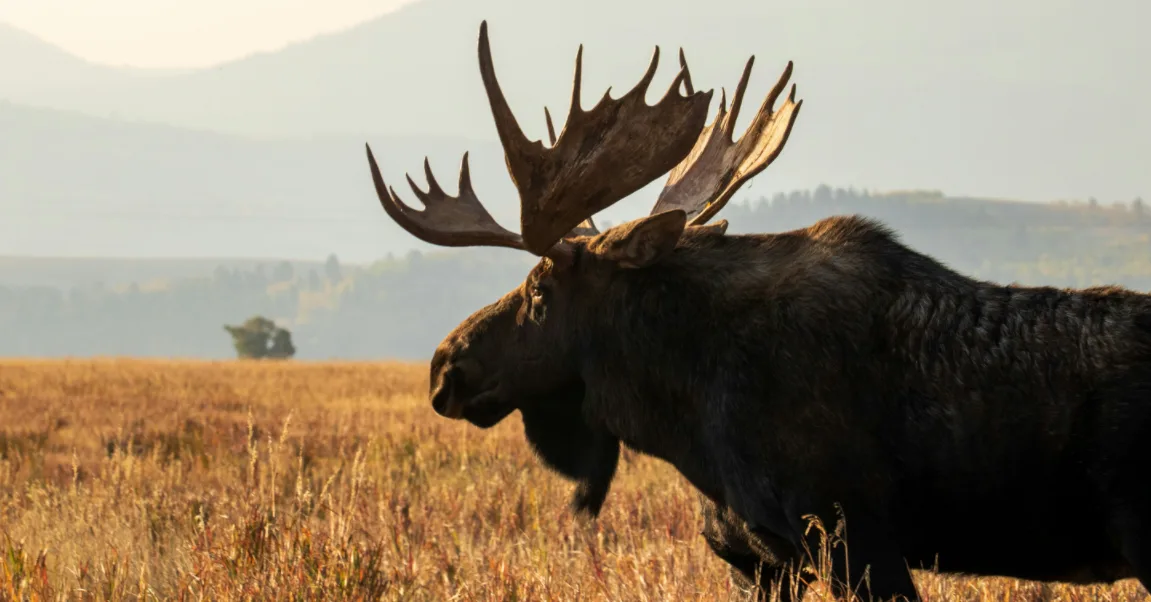
Moose are some of the most iconic and awe-inspiring wild animals in North America. These massive mammals capture attention with their height, broad antlers, and sheer presence. But even among moose, some individuals grow to truly remarkable sizes.
Hunters, scientists, and wildlife enthusiasts often wonder about the largest moose ever recorded. These record-breaking bulls are celebrated for their massive antlers, extraordinary weight, and rarity.
In this article, we will explore the largest moose ever recorded in the United States and how they are measured, why some moose grow unusually large, and practical tips for hunters seeking giant bulls.
How Are Moose Records Measured?
Measuring moose records is a careful and systematic process that ensures accuracy and fairness. In North America, the Boone & Crockett Club (B&C) is the most respected authority for tracking big game records.
1. Submission and Documentation
Hunters who believe they have a trophy moose must carefully submit evidence to the Boone & Crockett Club. This usually includes the antlers or skull, high-quality photographs, detailed location information, and notes on the animal’s age or condition.
Some hunters also provide tissue or DNA samples to confirm species identity and verify the bull’s subspecies. Precise field measurements, such as circumference, antler length, palm width, and spread, are essential for scoring.
Including additional details about the habitat, weather conditions during the hunt, and the method used improves the credibility of the submission and helps the judges make accurate evaluations.
2. Official Scoring System
The Boone & Crockett scoring system evaluates moose based primarily on antler characteristics. Judges examine antler spread, palm size, beam length, tine number, and symmetry. Symmetry is especially important, as even minor irregularities can significantly reduce the overall score.
Points are also added for antler mass and the fullness of the palm area. Judges carefully review all submitted evidence, including photographs, measurements, and field notes, before determining the final score.
They may compare the trophy to past records to ensure consistent scoring standards. This meticulous process ensures fairness and accuracy, and it preserves the integrity of the trophy record system over generations.
3. Verification Process
Once a hunter submits a moose record, B&C judges begin a thorough verification process to confirm its authenticity. The verification panel may travel to inspect the trophy in person or examine detailed photographs, videos, and measurements submitted by the hunter.
Judges may also consult with independent experts to validate unusual features or exceptionally large racks. Only after complete inspection and review is a moose officially recognized as a record.
This rigorous process prevents fraudulent claims and ensures only genuine, extraordinary bulls are added to the official record books.
Verification also establishes credibility for conservation data and future scientific studies, maintaining long-term reliability.
Top 5 Moose Ever Hunted In The United States
Across North America, the largest moose ever recorded are usually found in Alaska, Yukon, and other northern regions.
Here are the five most impressive moose ever documented, with stories behind their size, antlers, and hunts.
1. The #1 Largest Moose – Rex J. Nick’s Alaska Bull

- Score: 266-4/8 B&C points
- Location: Lower Yukon River, Alaska
- Hunter: Rex J. Nick
- Year: 2010
Score chart breakdown:
| Antler Measurements | Right | Left |
| Greatest Spread (A) | 76 0/8″ | |
| Normal Points (C) | 12 | 13 |
| Abnormal Points (B) | 1 | — |
| Palm Width (D) | 23 1/8″ | 22 5/8″ |
| Palm Length incl. Brow (E) | 53 6/8″ | 52 6/8″ |
| Beam Circumference (F) | 8 3/8″ | 8 4/8″ |
Nick hunted this massive bull along the Yukon River using a .300 Winchester Magnum. The moose had enormous antlers, with a wide palm and perfect symmetry.
What made this record unique was not just the size but also the difficulty of the hunt. Nick tracked the bull through dense willow thickets and icy riverbanks, waiting patiently for a clear shot.
This bull represents the largest moose ever recorded, holding the official world record for antler size and overall B&C score. The story of this hunt requires both patience and expertise, showing how top trophy bulls are often earned, not simply found.
2. Second Largest – Heinz E. Naef’s Yukon Moose (2013)
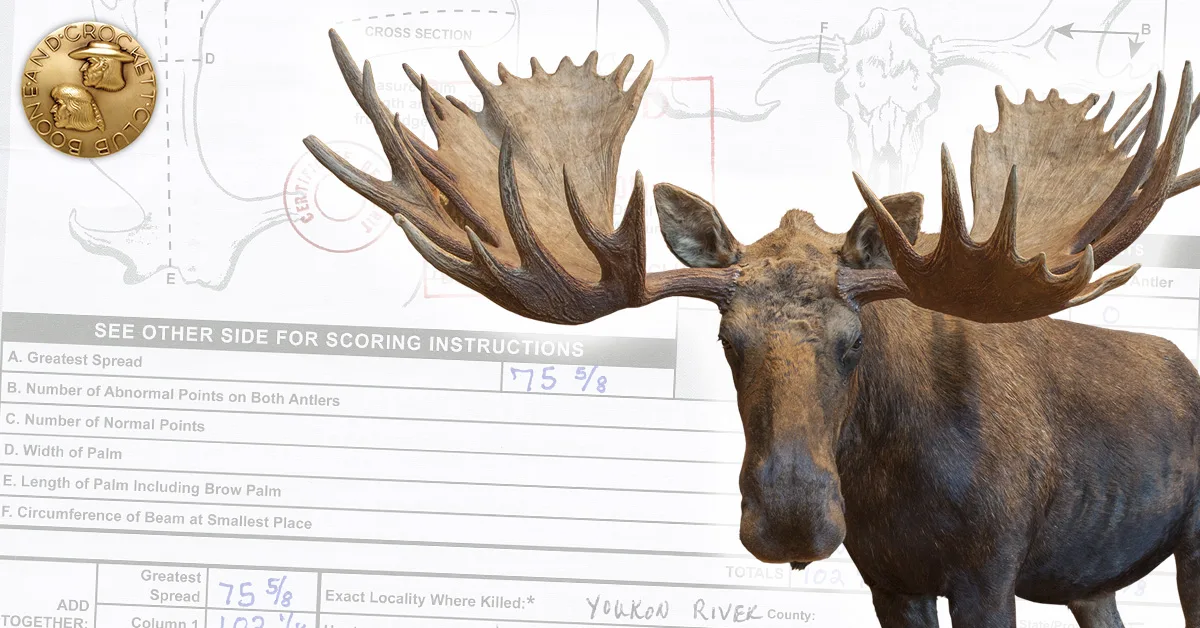
- Score: 263-5/8 B&C points
- Location: Yukon River, Yukon Territory
- Hunter: Heinz E. Naef
- Year: 2013
Score chart breakdown:
| Antler Measurements | Right | Left |
| Greatest Spread (A) | 75 5/8” | |
| Normal Points (C) | 19 | 17 |
| Palm Width (D) | 23 6/8” | 17 5/8” |
| Palm Length(E) | 50 7/8” | 51” |
| Beam Circumference (F) | 8 4/8” | 8 7/8” |
Naef’s moose was spotted during a self-guided hunt. Armed with a .303 British rifle, Naef approached within 35 yards before taking the shot. The antlers measured over 75 inches wide at their largest points, making them a trophy in every sense.
Unlike many trophy hunts, Naef was hunting for meat as well as sport. The bull’s size surprised him and contributed to its record status. Once submitted, the B&C judges verified its measurements, cementing its place in moose history.
3. Third Largest – John Crouse’s Moose (1994)
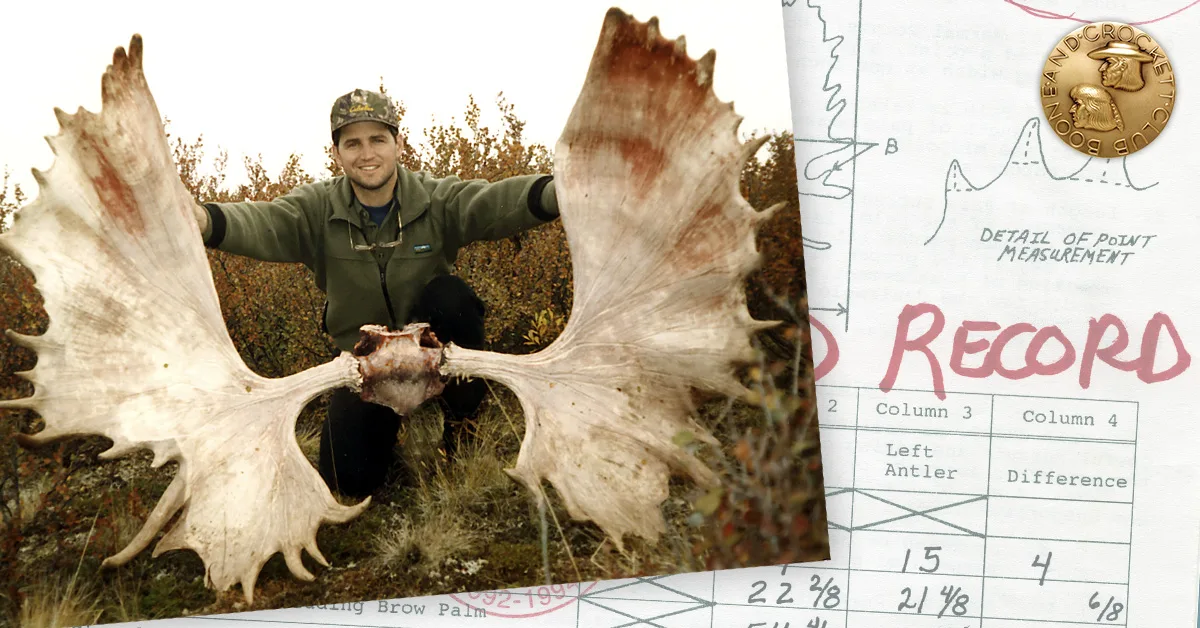
- Score: 261-5/8 B&C points
- Location: Fortymile River, Alaska
- Hunter: John Crouse
- Year: 1994
Score chart breakdown:
| Antler Measurements | Right | Left |
| Greatest Spread (A) | 65 1/8” | |
| Normal Points (C) | 19 | 15 |
| Palm Width (D) | 22 2/8” | 21 1/2” |
| Palm Length(E) | 54 4/8” | 53 3/4” |
| Beam Circumference (F) | 8 0/8” | 8 0/8” |
Crouse’s bull was hunted in remote east-central Alaska. Alongside a small team, he spotted the bull from a ridge and stalked it across several miles of tundra. They shot the moose with a .270 rifle and spent two full days packing the meat and antlers back to camp.
This moose remains one of the largest in U.S. history, notable for its massive antlers and the story of human endurance involved in the hunt. Its size is typical of Alaska-Yukon bulls, known as Alces alces gigas, the largest subspecies of moose.
4. Forth Largest – William G. Nelson’s Beluga River Moose (1997)

- Score: 256-6/8 B&C points
- Location: Beluga River, Alaska
- Hunter: William G. Nelson
- Year: 1997
Score chart breakdown:
| Antler Measurements | Right | Left |
| Greatest Spread (A) | 78 2/8” | |
| Normal Points (C) | 16 | 15 |
| Abnormal Points (B) | / | 1 |
| Palm Width (D) | 17 3/8” | 18 2/8” |
| Palm Length Brow (E) | 49 6/8” | 50 5/8” |
| Beam Circumference (F) | 7 5/8” | 7 6/8” |
William hunted this moose with his son Brian and a hunting partner Dean. They notice the moose from a drainage 250 yards away.
The bull had massive palms, making it difficult to aim at the vital parts. William had to wait patiently until it lowered its head. At the critical moment, the trigger was pulled, and the bull was down somewhere.
This hunt demonstrates the importance of patience and preparation when pursuing trophy bulls in remote areas. Without experience and knowledge, encountering and harvesting such a moose would be nearly impossible.
5. Fourth Largest – Kenneth Best’s McGrath Moose
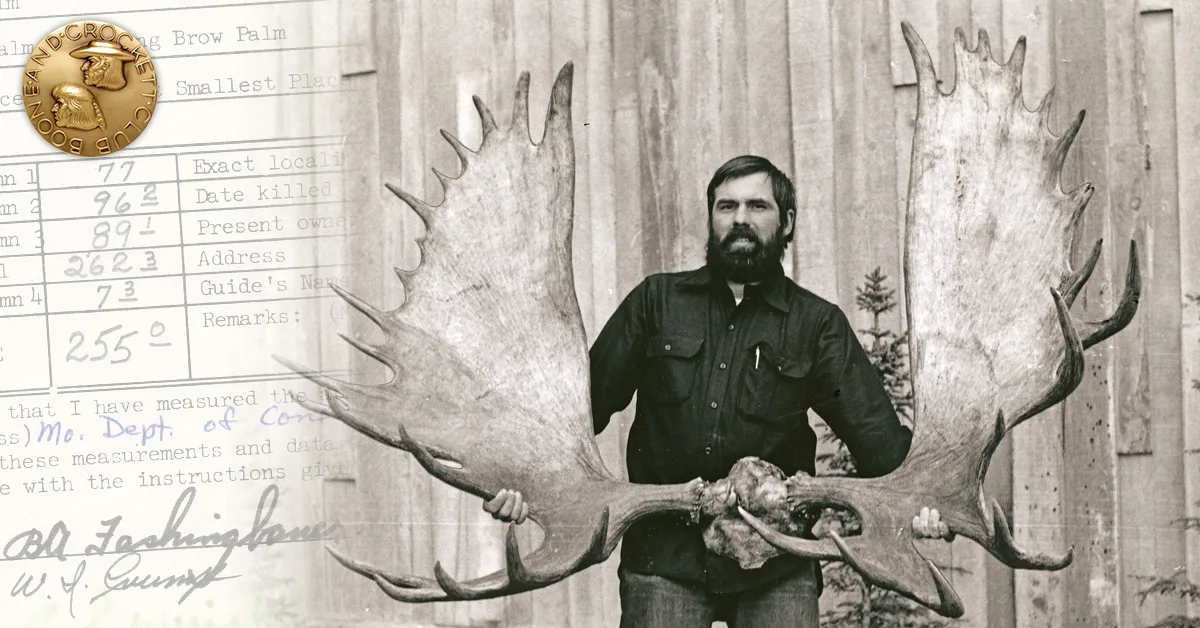
- Score: 255-0/8 B&C points
- Location: Near McGrath, Alaska
- Hunter: Kenneth Best
- Year: 1978
Score chart breakdown:
| Antler Measurements | Right | Left |
| Greatest Spread (A) | 77 0/8” | |
| Normal Points (C) | 18 | 16 |
| Palm Width (D) |
20 6/8”
|
15 6/8” |
| Palm Length(E) | 49 5/8” | 49 6/8” |
| Beam Circumference (F) | 7 7/8” | 7 5/8” |
Kenneth Best and his partner were floating along a river when they encountered this giant bull on a sandbar. The bull was massive, with heavy antlers and a broad spread. Best shot the bull in the shoulder, then finished with a follow-up shot in the neck.
This moose required significant effort to retrieve. Hunters often underestimate how challenging it can be to pack out a massive bull. Best’s hunt highlights the skill, patience, and preparation needed to secure record-worthy moose.
Why Some Moose Grow Huge?
Several factors contribute to why certain moose grow far larger than average. Understanding these factors helps explain why Alaska-Yukon bulls dominate record books.
1. Genetics
The Alaska-Yukon moose subspecies (Alces alces gigas) is genetically predisposed to large size. Bulls in these regions naturally grow heavier bodies and larger antlers compared to moose from southern populations.
2. Nutrition
Abundant food sources are crucial for large moose. River valleys provide willows, birches, and aquatic vegetation, which support rapid growth and antler development. Malnutrition can stunt antler and body size, even in genetically superior bulls.
3. Age
Older bulls are typically the largest. Antlers grow each year, adding mass and spread over time. Bulls in their prime (8 – 12 years old) often dominate trophy lists.
4. Low Predation
In regions with fewer predators, bulls survive longer, increasing their chance to reach record sizes. Wolves and bears can limit growth opportunities in more densely populated areas.
5. Stable Habitat
Undisturbed, wide-ranging habitats allow bulls to roam freely, find mates, and avoid constant competition. Open spaces and plentiful forage directly contribute to massive antler and body growth.
6. Selection Pressure
Hunters often target bulls with large antlers, which indirectly influences population genetics over generations. Trophy pressure may favor individuals that grow larger antlers.
Hunting Tips For Giant Bulls
Hunting a giant moose requires preparation, patience, and skill. Here are expert tips for those pursuing record-size bulls.
1. Scout Early
Study nearby water sources because big bulls visit them during warm afternoons. You can also monitor salt licks since moose return there repeatedly. Using trail cameras helps you understand exact movement patterns over several days.
2. Use Effective Calls
Carry a small funnel-style call to change pitch because bulls respond differently. You should practice soft calls too, since shy bulls dislike loud sounds. Observing cow behavior can also help you time your calls better.
3. Approach Carefully
Move during early morning light because shadows hide your movements well. You can also track wind shifts with simple powder bottles. Avoid ridges at midday since sunlight exposes your shape against the sky clearly.
4. Rifle Selection and Accuracy
Clean your rifle before every trip because dust harms accuracy. You should also test shooting from kneeling positions since moose rarely stand in open fields. A quality scope with steady magnification helps you take ethical shots.
5. Logistics and Pack-Out
Bring gloves with strong grip because wet hides are slippery. You should also plan multiple trips when carrying meat from thick woods. Using GPS markers prevents you from losing track of your load locations.
6. Document Your Hunt
Capture photos before field dressing because trophies always look better untouched. You can also store measurements in a notes app for safety. Including witness names improves your chances during official record verification.
Conclusion
The largest moose ever recorded is an extraordinary example of wildlife excellence. From Rex J. Nick’s world-record bull to Heinz Naef’s Yukon giant, these moose combine massive antlers, weight, and historical significance. Their size is influenced by genetics, nutrition, age, and habitat stability.
For hunters, pursuing a giant bull is a test of skill, endurance, and preparation. For enthusiasts, these record moose showcase the power and majesty of North American wildlife.
Understanding their history, biology, and the effort required to record them gives us a deeper appreciation of these giants. Whether you are a hunter, scientist, or wildlife admirer, studying the largest moose ever recorded reveals the remarkable potential of nature.
These animals remind us that, in the wilderness, patience, skill, and respect yield the most unforgettable encounters. How’s your moose harvest? Share your story with us and get a chance to receive any hunting gear we sell.
Check more: The Biggest Turkey Ever Killed Records
Leave a Reply