
If you have ever picked up a slate call, scraped it a few times, and thought “this sounds nothing like a turkey,” you are not alone. Most beginners put it down after five minutes and assume they are doing something fundamentally wrong.
The good news is that the slate call is actually one of the most forgiving calls out there. Once you understand the grip, the angle, and a few basic sounds, it starts to click fast.
This guide will walk you through everything you need to get started.
What is a Slate Call?
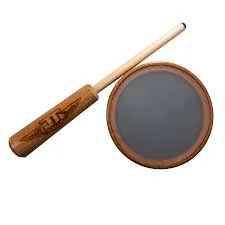
A slate call, also called a pot call, has three parts:
- The pot (a round, cup-shaped body),
- The surface (the material stretched or fitted across the top),
- The striker (a thin rod you drag across the surface to create friction and sound).
That friction is the whole thing. When the striker moves across the surface at the right angle and pressure, it vibrates and produces turkey sounds. The pot amplifies those sounds, kind of like a resonance chamber.
What makes it easier than a mouth call or box call? Control. You set the pace and control pressure. There is no learning curve around breath or mouth position.
Your hands do the work, and your hands are something you already know how to use.
When and Where to Use a Slate Call?
Slate calls work best at close to mid-range, roughly 50 to 150 yards. They are not the loudest option on the market, which is actually a good thing in many situations. Subtle, realistic calling often beats aggressive, loud calling.
They perform best in calm weather. Wind kills the sound quickly and also makes it harder for you to hear your own output, which means you lose feedback on what you are producing.
If it is a still morning and you have a bird that seems to be responding but hanging up, a slate call is often the perfect tool to pull it in closer.
Comparing 3 Common Pot Calls
Not all pot calls are the same. The surface material changes the tone, volume, and even how the call holds up in wet conditions.
Here is a quick breakdown:
| Surface Type | Tone | Volume | Best Used For | Notes |
| Slate | Soft, raspy, natural | Low to medium | Close range, calm days, pressured birds | Sensitive to moisture, needs conditioning |
| Glass | Crisp, clear, high-pitched | Medium to high | Windy days, open fields, long range | Works well in light rain or humidity |
| Aluminum | Loud, sharp, cuts through the wind | High | Big open areas, windy conditions | Less forgiving, can sound harsh if rushed |
If you are just starting out, slate is the go-to. It sounds the most natural and is the most forgiving when your technique is still developing.
How to Hold Your Slate Call For Better Control?
This is where most beginners go wrong. The sounds are secondary, and getting the grip right is the real foundation.
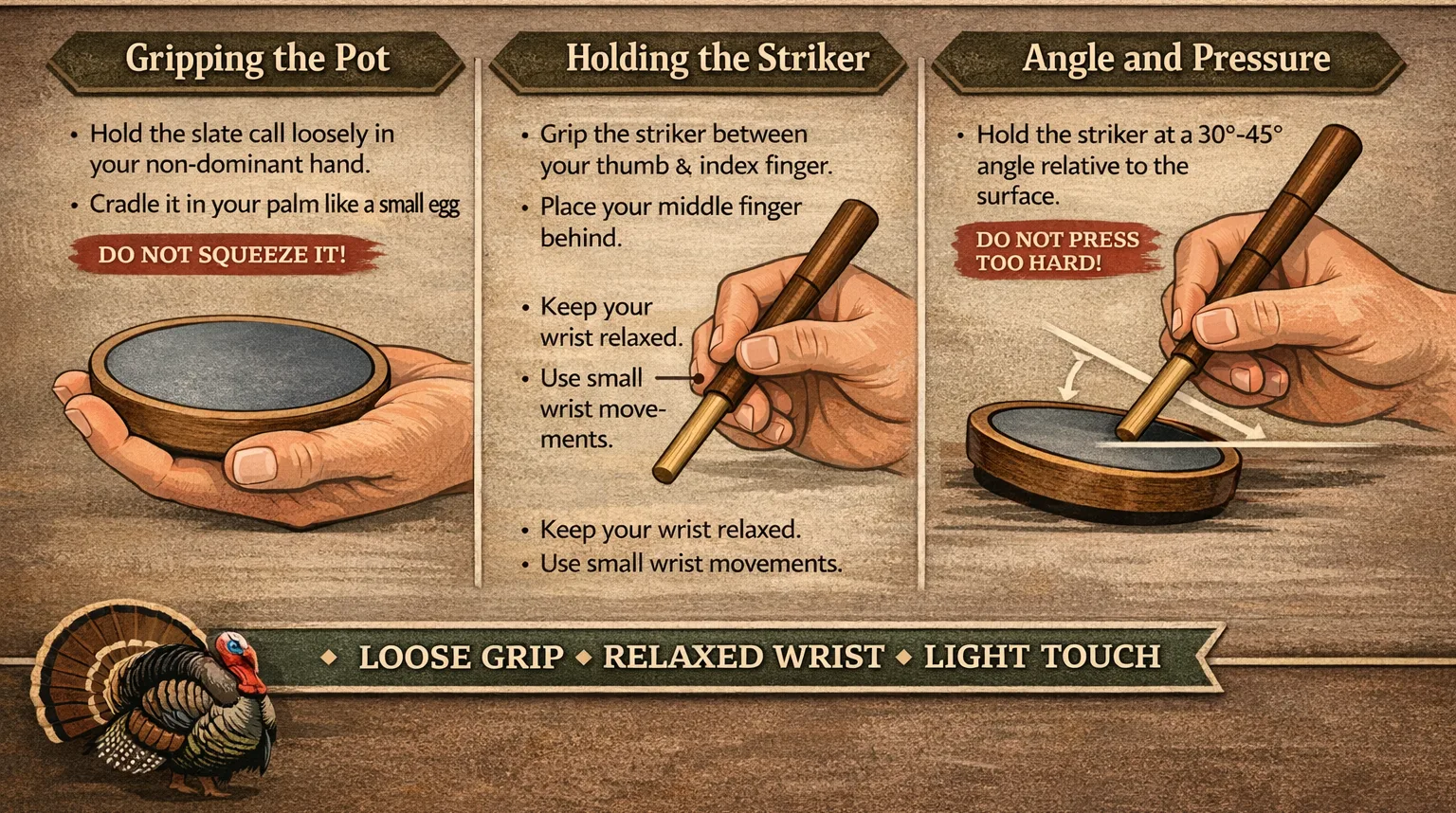
1. Gripping the Pot
Hold the pot loosely in your non-dominant hand, cradled in your palm. Think of it like holding a small bird egg. Your palm is underneath the pot, with your fingers curved gently around the sides. But don’t cover the sound ports.
Do not grip it tightly with your fingers because that chokes the sound chamber inside. The pot needs space to resonate. Keep it roughly level as well. Tilting it too far in either direction affects how the sound projects.
2. Holding the Striker
Most hunters like to hold the striker like a pencil. That is not the best way to do it. You should place the striker between your thumb and index finger, and then your middle finger behind it.
Your wrist should feel relaxed, almost loose. This is important because the sound comes from wrist movement, not elbow movement.
If you are moving your whole arm, you are working too hard, and the sound will be inconsistent. Small, controlled wrist circles or short strokes are what you are after.
3. Angle and Pressure
Hold the striker at about 30 to 45 degrees relative to the surface. Start with light pressure, lighter than you think you need. Let the friction between the striker tip and the surface do the work.
A lot of beginners press down hard trying to force the sound out, and it kills the tone. Ease in, find the friction sweet spot, and the sound will come naturally.
Basic Turkey Sounds to Start With
Though turkeys make different sounds in different seasons, you do not need ten different sounds to kill a turkey. Four will cover most of your early-season hunting. Check the following to hear what turkeys sound like:
1. Yelp
This is the most important turkey sound to learn. It is a two-note sound, a rising note followed by a falling one. On a pot call, you produce it with short oval strokes across the surface.
Start near the outer edge of the slate and move slightly inward to create a natural high-to-low yelp tone. The yelp is used for basic communication and locating other birds. A hen’s yelp is softer and slower.
Use it to check if a gobbler is in the area and to keep a conversation going with a responding bird.
2. Cluck
A single, short note. One quick stroke or a small circular pop on the surface. The cluck signals contentment, like a turkey saying “I am here, everything is fine.”
It is a low-pressure sound that does not spook birds the way aggressive calling sometimes can. Great for finishing a bird that is close but hesitating.
3. Purr
A soft, rolling sound made with a slow, light drag across the surface. You want the striker to barely move, almost trembling. Purring means a turkey is relaxed and feeding.
In a hunting scenario, it is great for calming a bird that has slowed down or seems nervous. It says “nothing to worry about here.”
4. Cut
A fast, sharp series of clucks, almost irregular in rhythm. It is an excited, aggressive sound. With a slate call, you produce it with quick, choppy strokes, like flicking it back and forth.
Use it to fire up a gobbler that has gone quiet or is losing interest. It can be effective, but use it carefully. Not every bird responds well to aggressive sounds, especially later in the season.
How to Practice a Slate Call Effectively?
1. Listen to Real Turkeys First
Before you practice making sounds, spend time just listening to recordings of real turkey calls.
YouTube has plenty. Pay attention to rhythm, pacing, and how the sounds change depending on the mood. Your ear needs to develop alongside your hands.
2. Practice Daily, But Keep It Short
Ten minutes a day beats a two-hour session on the weekend. Short, focused practice builds muscle memory faster.
Pick one sound per session and work on it until it feels consistent.
3. Record Yourself
This sounds awkward, but it works. Record a short session and play it back. You will immediately hear what is off, whether the tone is too scratchy, the rhythm is uneven, or the notes are cutting out.
Your ears at the moment do not catch everything. A recording does.
4. Focus on Rhythm, Not Just Sound
Turkeys communicate in patterns. A hen yelping is not just making noise; she is saying something in a specific rhythm.
Practice keeping your sequences consistent. Three yelps. Pause. Two clucks. The timing matters as much as the tone.
5. Do Not Rush to Sound Aggressive
New callers often think that loud and aggressive gets more responses. Sometimes it does. But the turkey hunters who consistently bring birds in tend to be the ones who call softly, patiently, and let the bird do the work.
Bring your calls, get into the field and deploy your method that works best when combined with the strategies in our Complete Turkey Hunting Guide.
Common Beginner Mistakes and How to Avoid Them
Mistake #1: Touching the Slate Surface With Your Fingers
The oils from your fingers coat the slate and reduce friction, which kills the sound. Even one or two touches can make the surface slick.
The fix is simple. Keep your fingers off the surface and condition the slate periodically with a piece of fine sandpaper before and during your hunt. Light, circular sanding refreshes the texture.
Mistake #2: Calling Too Loudly or Too Much
Overcalling is probably the single most common reason hunters blow opportunities. A turkey that hears the same loud calling over and over will either go quiet or walk away.
Start every sequence softly. Increase volume only if the bird seems to be moving away or not responding at all. And when a bird is closing in, stop calling. Let it come. Silence works.
Mistake #3: Lifting the Striker Off the Surface Mid-Stroke
When the striker leaves the surface mid-movement, the sound cuts out abruptly and sounds nothing like a real turkey.
Keep the striker in contact with the surface throughout your stroke, whether you are doing ovals, circles, or short drags. Practice slow, deliberate strokes first until the habit is built in.
Mistake #4: Using Only One Call All Season
Pressured turkeys, especially later in the season, have heard the same calls from hunters over and over. They learn to associate those sounds with danger.
Rotating between a slate call, a box call, and maybe a mouth call throughout the season keeps your setup sounding fresh and less predictable.
If you are not ready for a mouth call yet, having both a slate and a box call is a good start.
Troubleshooting Your Slate Call
- Slate turkey call not making a sound. The surface is likely too smooth or contaminated with moisture or oils. Sand it lightly with 220-grit sandpaper in small circular motions. Also, check your striker tip. If it is worn down or glossy, rough it up lightly as well.
- Call sounds scratchy or screechy. Usually means too much pressure on the striker or too steep an angle. Ease up on the pressure and lower the striker angle slightly. Slow your stroke down.
- Only getting faint sounds. The striker angle is probably too shallow, or you are not generating enough friction. Try increasing the angle slightly and add just a little more pressure. Check that you are not gripping the pot so tightly that you are dampening the resonance.
- Call sounds good at home but not in the field. This is a humidity issue. Moisture in the air, dew on the surface, or sweaty hands can all affect friction. Keep the call in a dry pouch and recondition the surface before your hunt. Some hunters carry a small piece of sandpaper in their vest for mid-hunt touch-ups.
- The striker keeps slipping. The tip of the striker needs more texture. Rough it up lightly with sandpaper. Also, revisit your grip. If you are holding the striker too far down toward the tip, you have less control. Move your grip higher.
Final Thoughts
The slate call is a tool that rewards patience more than talent. Most people who struggle with it are either gripping too hard, pressing too hard, or expecting it to sound perfect in the first week.
It does not work that way. Give yourself time to build the feel for it, listen closely to real turkey sounds, and practice the basics before you start chasing more complex calls.
Get the yelp and the cluck sounding clean, and you already have what you need for most hunting situations. The rest builds on top of that naturally.






Leave a Reply